Why Trying to Control Your Thoughts Can Make Social and Performance Anxiety Worse
The below information is based on my training and experience working with many clients with performance and public speaking anxiety. It is for your information only and does not constitute clinical advice or establish a patient-therapist or client-coach relationship.
A large part of social, performance and public speaking anxiety is not simply fearing that something bad will happen. It is struggling with the fact that we cannot know for certain that the worst thing will not happen.
A thought enters your mind ahead of an event such as:
Oh no, it will go bad; or
What if I panic during the presentation?; or
What if I go blank?; or
Why is my anxiety back?; or
What if my anxiety never goes away?
These thoughts are difficult partly because there is no way to solve to them. We cannot guarantee how you will feel then. We cannot guarantee you won’t have a panic attack. We don’t know for certain why your anxiety suddenly had a flare. We can’t know for sure what people think of us.
You and me do not like this. We want to solve this problem of anxiety, and a result this thought must be dealt with. The moment we engage with this thought we begin to trap ourselves in a loop. This can become one of the mechanisms that keeps anxiety, and particularly the fear of fear itself, going.
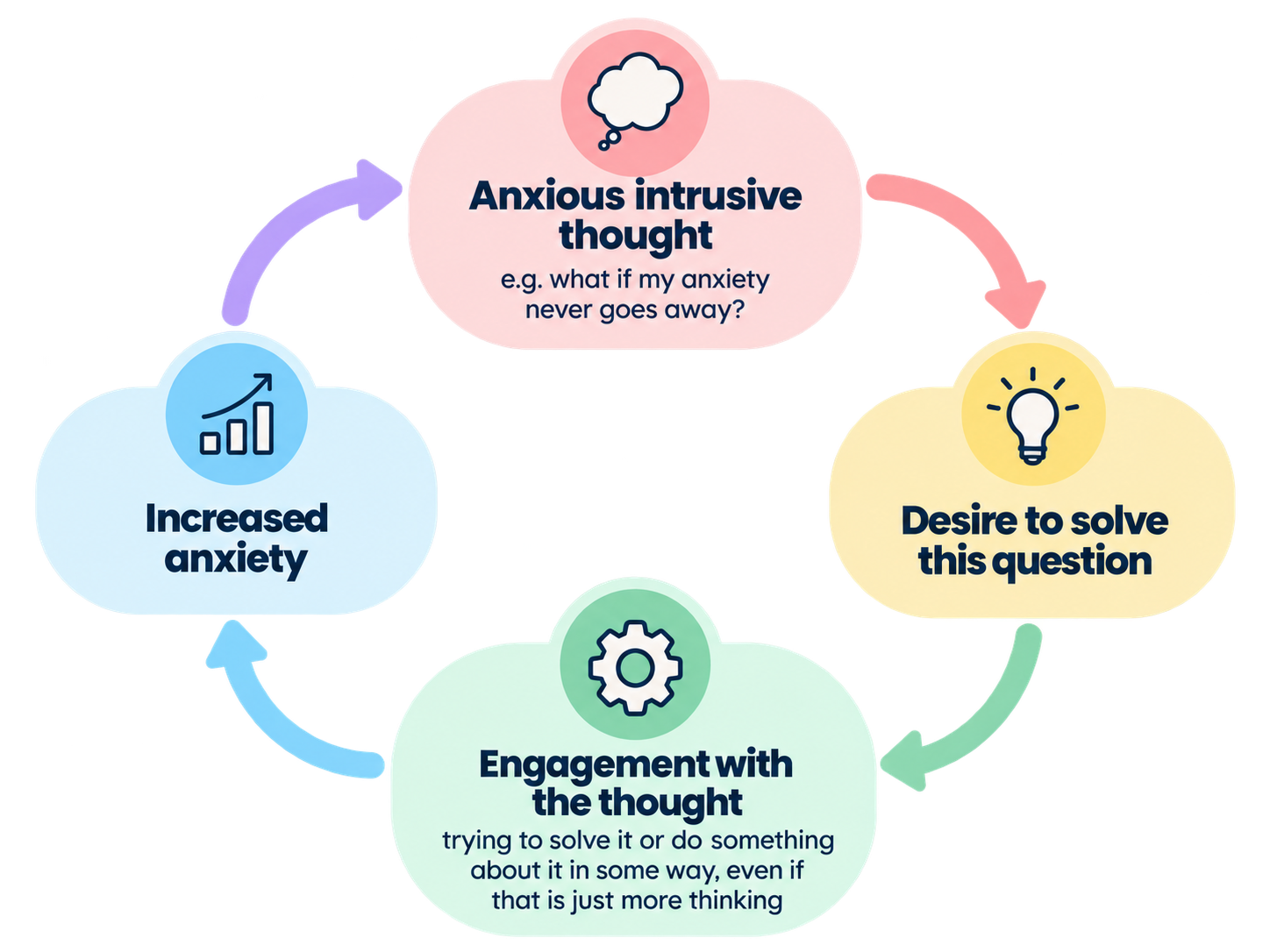
Three Ways People Respond To Uncomfortable Thoughts
People often develop quite sophisticated ways of trying to manage this uncertainty and many do not realise they are doing it because they think it is helpful analysis.
But it’s often not, and is attempting to ensure the outcome of making sure the feared outcome does not happen.
1. Mentally Solving the Future
One common response is repeatedly trying to work out what will happen. A thought pops in….. what if I get anxious?
You might replay previous situations, imagine possible scenarios, analyse someone's reaction, explore other options for support, predict how anxious you will feel, save the problem to think about later, or mentally rehearse what you will do if something goes wrong.
The mind is effectively saying: if I think about this for long enough, perhaps I can finally know or solve this problem.
But you cannot fully answer that question, you end up looping and looping, whilst your anxiety edges up in the background. You will never be able to come to a conclusion that it definitely won’t happen, which makes you feel more anxious and out of control. This makes the first thought feel even more real.
2. Trying to Keep Certain Thoughts Out
Sometimes people respond to uncertainty by attempting not to think about the feared possibility at all.
Don't think about panicking.
Stop imagining yourself going blank.
Don't think about what they might think of you.
Go to the gym for 2 hours before the talk to distract yourself
This can work briefly.
But deliberately trying not to think about something requires the mind to keep checking whether the thought is there. It also signals to the brain that this thought is dangerous if you go near it. You are directing attention outwards whilst keeping one eye inwards.
If I tell myself: do not think about having a panic attack part of my mind has to keep asking: Am I thinking about having a panic attack?
If I tell myself: go to the gym for 2 hours before the presentation to not think about it part of my mind has to keep asking But what if you think about it again?
The thought therefore remains psychologically important. The person is not simply having a thought. They are now also trying to manage whether that thought enters awareness.
3. Convincing Ourselves Everything Will Be Fine
Another extremely common strategy is trying to make ourselves feel certain that the feared outcome will not happen.
You'll be fine.
Nobody will think you're incompetent.
You definitely won't panic.
Everyone will like you.
You've got nothing to worry about.
There is nothing inherently wrong with encouraging ourselves but the difficulty occurs when reassurance becomes an attempt to cancel uncertainty and solve a thought.
If I need to convince myself that I definitely will not panic before I can enter the room, then the possibility of panic remains dangerous. If I need to believe that everybody will think I am competent before I can speak freely, then being perceived negatively remains something I must prevent.
The mind becomes dependent upon convincing ourself before it can feel safe, and because social situations rarely provide complete certainty, reassurance often has to be repeated.
The Paradox of Control
All of these strategies are attempts to reduce the possibility of something unwanted happening.
And it is important to be clear about what I am not saying.
We are not trying to make ourselves panic.
We are not hoping that we embarrass ourselves.
We are not trying to become incompetent.
We are not trying to make other people dislike us.
The shift is that we no longer want to engage in an internal safety behaviour of trying to control, manage or problem-solve anxious thoughts. This only makes us more anxious.
There is a difference between: I don’t want to panic and I might panic and I might not.
There is a difference between: will my anxiety ever go away? and maybe it will, maybe it won’t
The feared outcome can still be undesirable but we stop trying to solve it. Why? Because….
Control Can Produce the Thing We Fear
Ironically, attempting to tightly control uncertainoutcomes and thoughts can sometimes make the feared experience more likely.
Imagine you have a presentation coming up and have the thought ‘don’t mess that up’. You begin to solve that thought weeks before it’s happened…. how will I mess it up? what should I do? shall I cancel? what should I do? it’ll be fine. i’ll be ok. but what if I’m not?
Weeks pass with this anxiety building up in the background. The effort to ‘solve’ an anxious thought has created a state of intense rumination that makes anxiety more prominent.
Imagine you didn’t do anything about that thought at all, and didn’t engage with it… how might you feel?
This is where anxiety, and particularly the fear of fear itself becomes self-generating, the anxiety is caused by the very fear of anxiety.
Allowing the Question to Remain Unanswered
A different approach is learning to recognise when the mind is asking a question that cannot currently be answered.
What if I panic?
Maybe I will. Maybe I won't.
What if they think I'm stupid?
Maybe they will. Maybe they won’t.
What if I go blank?
It is possible. It’s also not.
This can initially sound frightening because people sometimes hear it as pessimism or giving up, it is not pessimism.
It is refusing to manufacture certainty where certainty does not exist.
The aim is not to replace:
Something terrible will happen
with:
Everything will definitely be fine.
It is becoming increasingly able to say: I don't know exactly what will happen, and I relinquish the responsibility to solve this thought.
You might be thinking…. ok, but what it it DOES happen?
Firstly, this is less likely if you have not been engaging in anxious rumination as you will be less anxious. If it does happen, it’s not because you didn’t think about it.
Finally, asking but what if it does is another anxious thought. You need to repeat the same process. Maybe it does. Maybe it doesn’t.
You may try this out and then think, what if it doesn’t work? Maybe it won’t, maybe it will.
The Goal Is Not Certainty
People sometimes assume that recovery from social or performance anxiety means eventually reaching a point where they know they will be okay.
But confidence is not feeling no fear or anxiety, it is often the absence of a response to it. It’s the ability to allow the uncertainty and do nothing about it.
When you notice these thoughts pop up, rather than trying to control or solve them, perhaps try to relinquish control of doing so.
The answer to the thought becomes: maybe it will… maybe it won’t… but I choose to do what I want.